Pointy Hat, Concrete Dreams: The Secret Society Living on Britain's Front Lawns
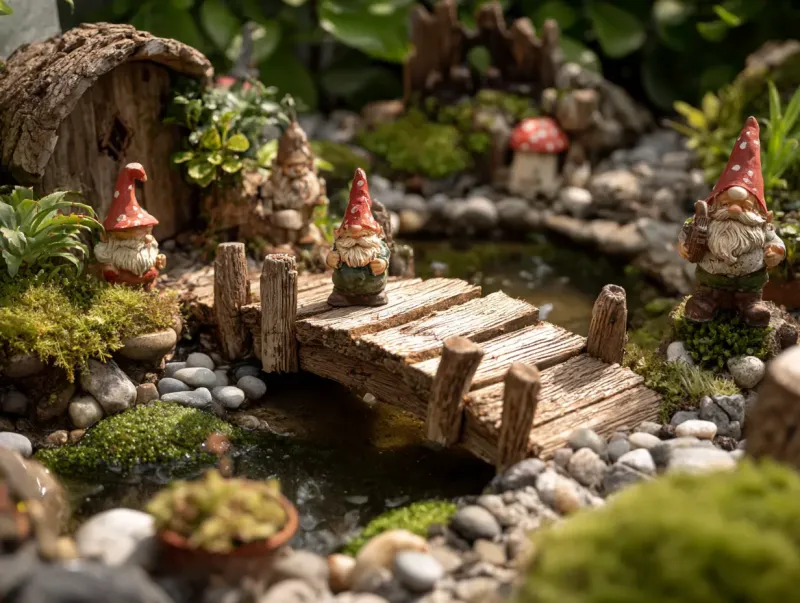
Photo: garden gnome diving into small pond funny british garden, via designmydwell.com
Every front garden in Britain tells a story. Most of them are boring — a hedge, a bin, a slightly optimistic hanging basket. But some, the good ones, are populated by an entire civilisation of small ceramic men in pointy hats, all frozen in various states of manufactured whimsy.
We're talking, of course, about the garden gnome. And make no mistake: gnome placement is not an accident. It is a language. And if you walk down any residential street in Britain, you can read it fluently once you know the rules.
The Pose Is the Punchline
Let's start with the canon. Gnome poses have been refined over a century of ceramic comedy, and each one says something specific about the household. Our official ranking:
1. The Mid-Dive. The undisputed champion. A gnome frozen in full swan dive above a pond that is, statistically, about nine inches across and algae-green. It's absurd. It's committed. It's the British sense of humour cast in concrete. No notes.
2. The Fishing Gnome. Rod out, patience eternal, catching absolutely nothing in a garden that contains no fish. A meditation on hope. A tiny ceramic Sisyphus with a beard.
3. The Mooning Gnome. Crude, yes, but it filters your neighbours for you. Anyone who complains about it has already told you everything you need to know.
4. The Solar Lantern Holder. Functional, warm, and faintly corporate. The gnome as infrastructure. We respect it, we don't love it.
5. The 'Tasteful Single Gnome'. One minimalist figure, artfully placed among the heucheras, presumably purchased from a garden centre with a café. This gnome has a podcast. This gnome thinks it's better than the diving one.
The Pavement View: Placement Is Everything
Now, the unwritten rules. Gnome placement visible from the pavement follows a strict etiquette that nobody has ever written down, until now.
Gnomes near the gate are greeters — public-facing, friendly, safe for the vicar. Gnomes tucked among the flowerbeds are for the homeowner alone; a private relationship. Gnomes on the wall or perched on the water butt? Those are lookouts. Sentinels. That household is running a full perimeter operation.
And then there's the ensemble cast: six, eight, twelve gnomes arranged in a semicircle around a wishing well. This is not decoration, this is a commitment. These people have a system. These people have named them.
The Feud You Know About
Of course, none of this happens in a vacuum, because for every gnome enthusiast there is a neighbourhood association type armed with the words "character of the area" and a laminated agenda.
We've all seen it play out. A resident installs a diving gnome; a complaint is filed; the local Facebook group splits into factions. On one side: joy, whimsy, property values be damned. On the other: people who use "kerb appeal" unironically and have never once laughed in their own garden.
Here's our position, and it's a firm one: a garden that provokes a committee meeting is a garden that's doing its job. The gnome is not the problem. The gnome is the symptom of a household that has decided happiness is worth more than symmetry.
Bring the Drama Home
If you've read this far and felt the faint pull of a pointy hat in your soul, don't fight it. Start small. One fisherman. One diver. See how the garden responds.
And if the neighbourhood association comes knocking, remind them that the gnome was here first — figuratively, and possibly, given the quality of some of these casts, geologically.
Proper daft? Absolutely. Proper brilliant? You'd better believe it.