Lift the Lid, Break Your Heart: Britain's Great Biscuit Tin Deception
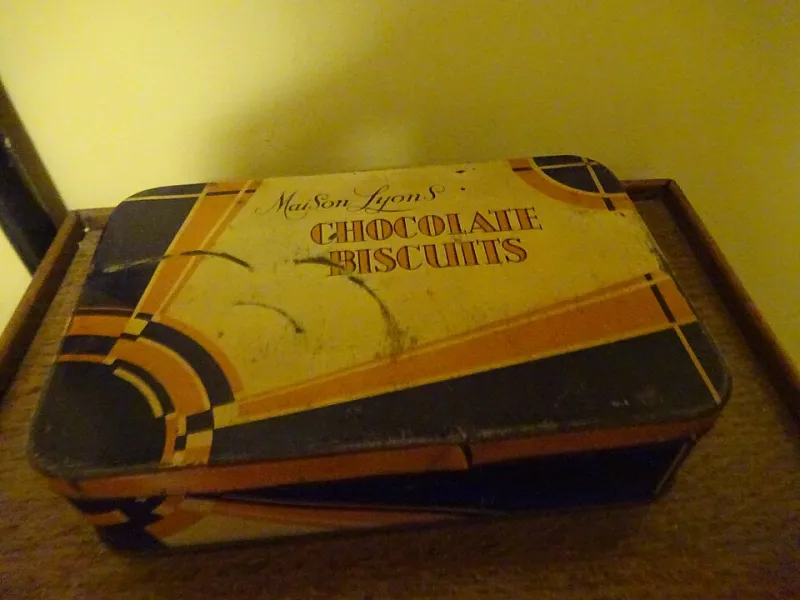
Photo: Vintage Fan 5678, CC BY-SA 4.0, via Wikimedia Commons
There is a moment, somewhere in every British household, when hope dies quietly in a kitchen. It happens the instant a hand — full of optimism, expecting a chocolate finger — lifts the lid of a biscuit tin and is met with sewing needles, a pile of receipts and a single allen key from a flat-pack wardrobe assembled during the Blair years.
The biscuit tin that contains no biscuits is not a quirk. It is not even a tradition. It is a full-blown national infrastructure, and today we're pulling back the lid on it. Literally. Hopefully. Expecting a custard cream. Finding a tape measure.
The Bait and Switch Nobody Signed Up For
Here's how the con works. A perfectly good tin — often a Quality Street tub or a Royal Doulton-style number that once held actual shortbread — enters the house full of biscuits. It is loved. It is raided. And then, at the exact moment it empties, a decision is made somewhere deep in the British psyche: this vessel has proven itself worthy of storage, and it shall never hold food again.
Nobody votes on this. Nobody announces it. The tin is simply repurposed overnight, and the household's collective memory is wiped. Weeks later, a family member spots it on the shelf, brain lights up with the word 'biscuits', and the cycle of betrayal begins anew.
It's a design problem, really. The tin promises one thing and delivers another. At Mad Lad Designs we respect a bit of visual mischief, but even we draw the line at emotional damage via stationery container.
What's Actually in There: The Evidence
We asked around, and the contents of Britain's decoy tins read like the inventory of a very anxious inventor:
- Buttons. So many buttons. Nobody has ever used one of these buttons.
- Batteries. Always half-corroded. Never the size anyone needs.
- Screws and allen keys. The emotional support leftovers of every IKEA purchase since 2004.
- A tape measure. Locked. Jammed. Retired.
- Birthday candles. Three. One bent.
- Foreign coins. Drachma, actually.
- Rubber bands, in a state of slow, sticky decomposition.
- The spare key to a door that changed hands years ago.
One reader confession described a tin containing only a single wine cork and 'a small brass thing, purpose unknown, feared by all'. Another reported a tin of tins — a biscuit tin inside a biscuit tin, like a Russian doll of disappointment.
So Does Anyone, Anywhere, Keep Biscuits in One?
We investigated this with the seriousness it doesn't deserve, and the answer is: theoretically, yes. Historically, certainly. In practice, no. The moment a biscuit tin proves it can hold biscuits, it is promoted — promoted out of the pantry and into the junk drawer economy, never to hold food again.
It's the same logic that keeps good towels unwrapped and the nice plates in a cabinet. Britain does not trust its own possessions to be used for their intended purpose. Function is a one-time offer; after that, you're decorative.
The Lid Lift: A Psychological Autopsy
Why do we keep falling for it? Because the tin is doing its job beautifully. That embossed lid, that satisfying pop, that faint whiff of a Christmas long gone — it's brilliant packaging. The tin says biscuits even when it's full of somebody's broken umbrella parts.
And maybe that's the charm. The decoy tin is a tiny, harmless con we run on ourselves, generation after generation. It's the British way: never let an empty container go to waste, and never let a hopeful relative go un-disappointed.
So here's our position: keep the tin. Fill it with whatever chaos you like. But if you're going to betray your loved ones on a weekly basis, do it with style — that's where we come in. Proper daft designs for proper brilliant people, and absolutely no buttons in the biscuit tin. Probably.